
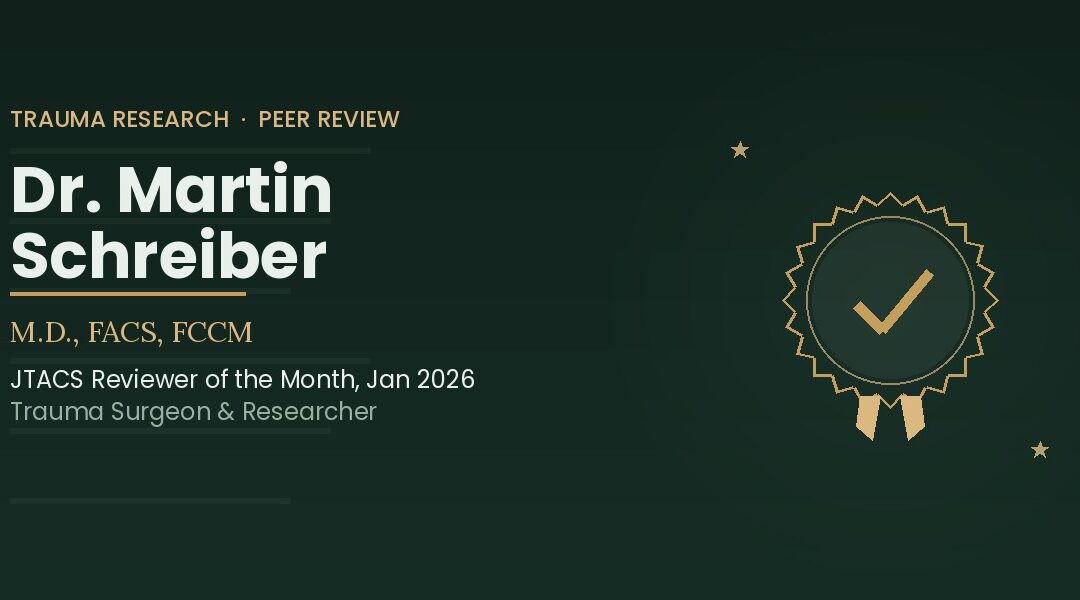
When a trauma team makes a fast decision about how to stop bleeding or protect an injured brain, that decision rests on research. Someone had to run the study, and someone had to check that the study was sound before other surgeons trusted it. Dr. Martin Schreiber has spent his career on both sides of that process. He produces the research, and he helps guard the quality of the research that others rely on.
That second role earned him fresh recognition in early 2026, when he was named the Journal of Trauma and Acute Care Surgery’s Reviewer of the Month for January 2026. The honor points to a part of medicine that patients rarely see but depend on every day.
Why Peer Review Matters in Trauma
Peer review is the quality check behind published medical research. Before a study reaches surgeons, emergency physicians, and trauma teams, reviewers examine its methods, question its assumptions, and press on its conclusions. Strong review sharpens good studies and catches weak ones. In trauma, where findings can change how teams treat the most critically injured patients, that filter carries real weight.
Dr. Schreiber’s reviews are known for being timely, thoughtful, and clinically grounded. He reads new work through the eyes of someone who has actually treated these patients, which lets him spot the difference between a result that looks good on paper and one that will hold up in a real trauma bay. His recognition from the journal reflects the trust the field places in that judgment.
A Researcher Who Has Shaped the Field
Dr. Schreiber does not only evaluate research. He produces it. Over his career he has authored more than 350 peer-reviewed publications and has become a widely cited voice in trauma resuscitation and surgical critical care. His work, supported by the Department of Defense, the National Institutes of Health, and industry partners, has helped shape modern thinking on damage control resuscitation, the coagulopathy of trauma, and prehospital care for severely injured patients.
His research keeps returning to the problems that cost the most lives, especially hemorrhage control and traumatic brain injury. That focus on turning hard questions into better bedside care is the throughline of his work, and it is the subject of a closer look at how he is changing the way trauma is treated.
From the Battlefield to the Journal Page
What gives Dr. Schreiber’s perspective its edge is where it comes from. He is a Colonel in the U.S. Army Reserve and has served in leadership roles during deployments to Iraq and Afghanistan, including work focused on trauma system development and combat casualty care. That experience has helped him connect battlefield medicine with civilian trauma practice, and it informs both the studies he runs and the studies he reviews.
He continues to work at that intersection today. He recently joined Madigan Army Medical Center as Director of Surgical Research, and he has written about that transition alongside his time at the field’s premier gathering in his account of the 59th TCCACS conference and his move to Madigan. Each of these roles feeds the others, keeping his clinical work, his research, and his editorial judgment closely tied together.
Strengthening the Science Behind Trauma Care
Recognition as a Reviewer of the Month may sound like an inside honor, but its effect reaches patients. Every reliable study that guides a trauma team passed through review, and careful reviewers help make sure that guidance is trustworthy. By pairing his own research with rigorous peer review, Dr. Schreiber helps strengthen the science that trauma care depends on, both for the military and for civilian hospitals.
Frequently Asked Questions
What is the JTACS Reviewer of the Month recognition?
The Journal of Trauma and Acute Care Surgery names a Reviewer of the Month to recognize peer reviewers whose evaluations are timely, thorough, and clinically valuable. Dr. Martin Schreiber received the recognition for January 2026.
What does a peer reviewer do?
A peer reviewer examines a research study before it is published, checking its methods, assumptions, and conclusions. In trauma medicine, that review helps ensure that new findings are accurate and useful before surgeons and trauma teams rely on them.
What does Dr. Schreiber research?
His research centers on hemorrhage control and traumatic brain injury, along with damage control resuscitation, the coagulopathy of trauma, and prehospital care. He has authored more than 350 peer-reviewed publications, with support from the Department of Defense, the NIH, and industry partners.
What is Dr. Schreiber’s military background?
Dr. Schreiber is a Colonel in the U.S. Army Reserve who has served in leadership roles during deployments to Iraq and Afghanistan, including work on trauma system development and combat casualty care. That experience connects battlefield medicine with civilian trauma practice.